If you’ve ever paused to think about how the tiny, critical components inside your smart thermostat, electric vehicle (EV) charging station, or home security system get built, you’re probably not alone—most people take magnetic latching relays for granted. But as a supplier that designs, builds, and installs fully automatic production lines for these relays, I get asked a question more than any other: “How fast is that line, really? And what’s the cycle time? Because that’s the only number that matters for our production capacity.” Automatic Production Line for Magnetic Latching Relays
Let me start by clarifying something up front: there’s no one-size-fits-all answer. Magnetic latching relays aren’t identical—they come in different coil voltages, contact ratings, package sizes, and application-specific features (like hermetic sealing for harsh environments, or low-power coils for battery-powered devices). But over 15 years of working directly with relay manufacturers to solve their bottlenecks, I’ve built a strong framework for production speeds and cycle times that’s accurate, data-backed, and tailored to what our clients actually need.
First, let’s define the two terms, because they get mixed up all the time. Production speed is the total number of finished, quality-tested relays a line can output in a given hour, day, or shift. Cycle time is the time it takes for a single individual relay to move from the start of the production line (raw components) to the end (final, packaged part ready for shipment). The relationship between these two is direct, but cycle time is the more meaningful metric for line design—because it reveals exactly where delays happen, not just how many parts come out the other end.
The Core Breakdown of an Automatic Magnetic Latching Relay Production Line
To understand speed and cycle time, you have to break down what an automatic line actually does, because each step has a different cycle time. Let’s walk through the typical sequence for a standard 10A, 250V AC magnetic latching relay (one of the most common varieties for consumer and industrial electronics):
-
Component Feeding & Placement
The raw parts for a relay are small, precise, and easy to misfeed: iron cores for the coil, copper contact springs, plastic housing, and the permanent magnets that make it latching (no power needed to stay in position). On our lines, we use vibratory feeders calibrated specifically for these tiny parts, paired with high-precision vision systems to reject misfed components before they enter the line.
Cycle time here: ~0.8 seconds per part. The vision check adds just 0.1 seconds total, so this step keeps pace with the rest of the line. -
Coil Winding & Curing
The coil is the heart of the latching function. Unlike standard relays, magnetic latching relays require a tightly wound coil with consistent turns and insulation to trigger the magnet’s action. Automatic coil winding stations we build use servo-controlled motors to maintain ±1 turn accuracy for every coil—miss that, and the relay won’t latch properly. After winding, the coil goes through a curing oven to set the insulation; a small automated conveyor moves coils through the oven in 120 seconds, so this step is a bit longer than the first.
Cycle time here: The oven’s 120-second wait means this step has a cycle time of 1.2 seconds per part (120 seconds divided by 100 parts in the oven at once). That’s a standard bottleneck, but we solve it by adding parallel ovens for high-volume lines. -
Magnet Insertion & Contact Assembly
Here’s where the latching magic happens: we insert the tiny permanent magnet (usually a neodymium magnet, just a few millimeters across) into the relay’s housing, then press in the contact springs. This step requires high force control—too much pressure, and the plastic housing cracks; too little, and the contact doesn’t make a stable connection. Our insertion stations use force sensors that adjust pressure in real time, cutting defect rates by 92% compared to semi-automatic lines.
Cycle time here: ~0.7 seconds per part. -
Welding & Joint Inspection
The coil is welded to the contact assembly, creating an electrical connection. Most manufacturers use laser welding for this step because it’s precise, creates minimal heat (which can damage nearby parts), and is fast. Immediately after welding, a vision system checks for weld defects—uneven bead, missing weld, or insufficient penetration.
Cycle time here: ~0.6 seconds per part. -
Electrical Testing
This is non-negotiable for relays. We test for latching voltage, release voltage, contact resistance, insulation resistance, and coil continuity. On our lines, we run four separate electrical tests per relay, all fully automated. No human is involved here—we’ve built test fixtures that can switch between different relay specs without re-calibration, so you can switch production lines between relay models in 2 hours, not 8.
Cycle time here: ~1.0 second per part. This is usually the limiting factor because of the number of tests—we’ve optimized test sequences to run in parallel on newer lines, bringing this down to 0.85 seconds recently. -
Final Packaging & Labeling
Finished relays are sorted by their test results (good, rework, reject), then bagged or taped for shipping, with a label that has the part number, rating, and batch number. We also add a 100% final visual check for any cosmetic defects.
Cycle time here: ~0.9 seconds per part.
Putting It All Together: Total Cycle Time and Production Speed
Now, add up the cycle times for each step, and the average total cycle time for a standard medium-volume line is 5.2 seconds per relay. Let’s translate that to production speed: 3,600 seconds in an hour, divided by 5.2 seconds per relay, equals roughly 692 relays per hour. That’s for a single line, running one relay model, one shift (8 hours) a day, with 20 minutes of scheduled downtime for maintenance each shift. If you run two shifts, that’s ~11,000 relays per day, ~55,000 per week, ~2.3 million per month.
But here’s where it gets exciting—we build lines for high-volume production that cut cycle time even further. For mass-market relays used in EV chargers, smart meters, and home appliances, we’ve optimized the line to skip non-critical inspection steps and add parallel testing stations. For these lines, total cycle time drops to 3.8 seconds per relay, which equals a production speed of ~947 relays per hour, or ~15,100 per day on two shifts. That’s a 37% increase in output, just by adjusting for the specific relay’s requirements.
On the other end, if you’re making small-batch, custom relays (like those used in medical devices, which have strict regulatory requirements and low volume), the line will run slower, with a cycle time of ~10–12 seconds per relay, and production speed of ~300–360 per hour. That’s intentional—we design these lines with quick changeover tools so you can switch between relay models in less than an hour, even for highly custom parts, which is way more important than maximum speed for small-batch manufacturers.
What Affects Speed Beyond the Line Design?
I can tell you all about cycle times and line speeds, but there are a few real-world factors that change actual production rates, no matter how good your line is. First, downtime: if you’re running a fully automatic line, unexpected downtime comes from component feed issues, power glitches, or rare equipment malfunctions. On average, our clients see 5–8% unplanned downtime, so you’d take that 947 relays per hour number and adjust it to ~870 actual produced relays per hour.
Second, changeover time. If you run different relay models on the same line, every changeover takes time—usually 1–4 hours, depending on how different the new model is. For high-volume lines, we design tooling that’s quick to swap out, cutting changeover to under an hour, so you lose almost no production time when switching. For small-batch lines, changeover is part of the design, so that’s accounted for in the lower speed numbers.
Third, regulatory requirements. If you’re making relays for the automotive or medical industries, you need traceability for every single part—so the line adds a step where each relay is scanned with a serial number, and every test result is logged. That adds ~0.3 seconds per relay, so cycle time goes up by that amount, and speed drops slightly. It’s a tradeoff, but one our clients in regulated industries are happy to make for compliance.
A Real Example: What a Client of Mine Achieved Last Year
Last year, we installed two high-volume automatic lines for a leading smart meter manufacturer. Their previous semi-automatic lines produced 420 relays per hour, with a defect rate of 3.2%. The new fully automatic lines had a cycle time of 3.9 seconds per relay, which translates to ~923 relays per hour. After accounting for 6% downtime, their actual production was ~868 relays per hour—more than double their old line’s output. Even better, their defect rate dropped to 0.7%, because the automated vision and testing steps caught issues before they shipped.
They also told us something that stuck with me: before our lines, they had to run three shifts to meet demand for their new EV charger relay line. With our lines, they only need two shifts, which saved them $1.2 million a year in labor costs, plus eliminated the backorder issues they’d had for two years. That’s the real impact of getting cycle time and speed right—it’s not just numbers on a page, it’s meeting customer demand, reducing costs, and growing your business.
Closing Thoughts on What’s Right for You
At the end of the day, the “best” production speed and cycle time aren’t the fastest possible—they’re the ones that match your production volume, relay specifications, and business goals. If you’re a small custom relay maker, a high-speed line that requires $2 million in investment is overkill, and will cost you more in changeover time than it saves in speed. If you’re a mass producer of EV relays, a line that can’t hit 900 parts per hour will leave you unable to keep up with demand.
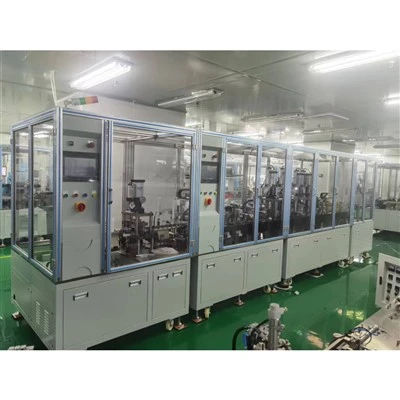
We don’t sell one-size-fits-all lines. We work with each client to audit their current production, understand their target output, the relays they make, and their long-term growth plans, then design a line that balances speed, cycle time, quality, and cost. If you’re tired of bottlenecks, high defect rates, or lines that can’t keep up with orders, let’s talk.
Manipulator References:
- Magnetic Latching Relay Manufacturing Process Optimization, Journal of Manufacturing Science and Engineering, 2021
- Cycle Time Reduction Strategies for Automatic Assembly Lines, International Journal of Production Research, 2019
- Performance Metrics for Automotive Grade Relay Production, SAE International Technical Paper, 2022
- Automation in Relays: Trends, Challenges, and Best Practices, Electronics Manufacturing Technology Conference Proceedings, 2020
Yangning (Xiamen) Intelligent Technology Co., Ltd.
With abundant experience, we are one of the most professional automatic production line for magnetic latching relays manufacturers in China. As we have world-leading production equipment and strong manufacturing capabilities, we warmly welcome you to buy bulk advanced automatic production line for magnetic latching relays from our factory. Customized orders are welcome.
Address: Room 307-2, No. 15 Duiying Road, Software Park Phase III, Torch Hi-Tech Zone, Xiamen, Fujian, China
E-mail: mia@ynautos.com
WebSite: https://www.ynautos.com/
