When it comes to drying clothes, households around the world have two prominent choices at their disposal: the traditional tumble dryer and the increasingly popular electric clothes drying rack. As a supplier of electric clothes drying racks, I’ve witnessed firsthand the growing interest in this alternative solution. This blog post aims to delve deep into a scientific comparison of the drying times between these two methods to help consumers make an informed decision. Electric Clothes Drying Rack
How Tumble Dryers Work
Tumble dryers operate by circulating hot air within a rotating drum that holds the wet clothes. There are two main types of tumble dryers: vented and condenser. Vented dryers expel the moisture-laden air outside through a hose, while condenser dryers collect the water in a container.
The drying process is highly efficient due to the continuous movement of clothes in the drum. As the clothes tumble, they come into contact with the hot air from different angles, accelerating the evaporation of water. The temperature inside the drum can usually be set according to the fabric type, typically ranging from gentle cycles around 40°C for delicate items to high – heat cycles up to 80°C for sturdier fabrics.
How Electric Clothes Drying Racks Work
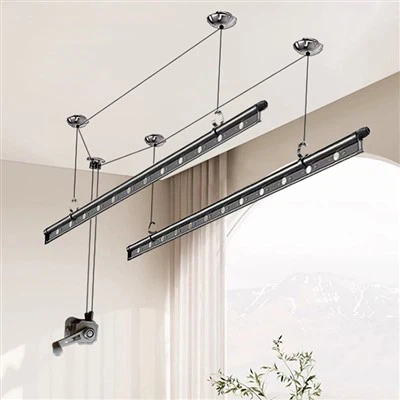
Electric clothes drying racks work on a relatively simpler principle. They are equipped with heating elements that warm the air around the wet clothes hanging from the rack. The warm air then absorbs moisture from the clothes, and the moisture is gradually released into the surrounding environment.
Most electric drying racks have adjustable settings for temperature and sometimes for the duration of operation. The temperature settings are generally lower compared to tumble dryers, usually in the range of 30 – 50°C. This is to prevent damage to the clothes, especially delicate fabrics.
Factors Affecting Drying Time
Fabric Type
Fabric type plays a crucial role in determining the drying time for both tumble dryers and electric clothes drying racks. Natural fibers like cotton and linen tend to absorb a large amount of water and can take longer to dry. Synthetic fibers, such as polyester and nylon, dry more quickly as they do not absorb as much water.
In a tumble dryer, the continuous tumbling action helps to disperse the moisture across the fabric evenly, reducing the overall drying time. For example, a cotton T – shirt might take around 40 – 60 minutes in a tumble dryer on a medium – heat setting.
On an electric drying rack, the drying process is more passive. Drying a cotton T – shirt could take anywhere from 2 – 4 hours depending on the temperature setting and the humidity in the room. Synthetic fabrics will dry much faster on both types of equipment, with a polyester blouse taking around 20 – 30 minutes in a tumble dryer and 1 – 2 hours on an electric drying rack.
Load Size
The amount of clothes being dried also significantly impacts the drying time. Tumble dryers are generally better at handling larger loads. They are designed to accommodate large volumes of clothes in the drum, and the air circulation system is optimized for this purpose.
If you overload a tumble dryer, the clothes may not tumble properly, leading to uneven drying and potentially longer drying times. However, a moderately loaded tumble dryer (such as a full – load of laundry for a family of four) can complete the drying process in about an hour or so.
In contrast, electric clothes drying racks have a more limited capacity. The heating elements are designed to heat the air around a certain number of clothes. If you hang too many clothes on the rack, the air will not be able to circulate effectively, and the drying time can increase significantly. For a small load of 3 – 4 items, an electric drying rack can dry the clothes within a few hours. But for a large load, it could take much longer, sometimes even overnight.
Humidity in the Environment
Humidity is another important factor. In a high – humidity environment, the air is already saturated with moisture. This makes it more difficult for the wet clothes to release their moisture, regardless of the drying method.
Tumble dryers are less affected by humidity because they either expel the moist air outside (vented dryers) or collect the water separately (condenser dryers). The internal heating and air – circulation systems can maintain a relatively stable drying environment.
On the other hand, electric clothes drying racks rely on the surrounding air to absorb the moisture from the clothes. In a very humid room, the drying time can be extended. For instance, in a coastal area with high humidity, drying times on an electric drying rack could be 50% longer compared to a dry inland area.
Advantages of Electric Clothes Drying Racks in Terms of Drying Time
Although tumble dryers are generally faster, electric clothes drying racks have some advantages that can make the drying time more acceptable in certain situations.
Firstly, they are ideal for small loads. If you only have a few items to dry, such as a pair of socks or a single shirt, using an electric drying rack can be quicker. You don’t have to wait for a full load to start the dryer, and you can set the rack up in a small space almost immediately.
Secondly, for delicate fabrics, electric drying racks can be a better choice. The lower temperature settings reduce the risk of shrinkage or damage to the fabric. While it may take longer to dry these items, the preservation of the fabric’s quality is often worth the extra time.
Conclusion
In conclusion, tumble dryers are generally faster than electric clothes drying racks, especially for large loads and in high – humidity environments. However, electric clothes drying racks have their own niche, being more suitable for small loads and delicate fabrics.

As a supplier of electric clothes drying racks, I understand the importance of providing a reliable and efficient solution for consumers. Our electric drying racks are designed to offer a balance between drying time and fabric safety. With adjustable temperature settings and efficient heating elements, we strive to minimize the drying time while ensuring that your clothes remain in excellent condition.
Clothes Drying Rack If you’re interested in learning more about our electric clothes drying racks or are considering placing an order for your home, business, or other needs, we invite you to contact us for a purchasing discussion. We are more than happy to provide detailed product information and answer any questions you may have.
References
- "Textile Science and Engineering" – A comprehensive textbook on fabric properties and drying processes.
- Industry reports on home appliances and their performance by leading market research firms.
Linyi Tianluo Intelligent Home Co., Ltd.
We are one of the most experienced electric clothes drying rack manufacturers in China, also support customized service. Welcome to buy high quality electric clothes drying rack for sale here from our factory. If you have any enquiry about cooperation, please feel free to email us.
Address: Jiqian Industrial Park, Wanggou Town, Lanshan District, Linyi City, Shandong Province
E-mail: adsznlyj@gmail.com
WebSite: https://www.ads-lyj.com/
